
Ramshackle apartment buildings on the edge of Thamel, Kathmandu’s old city, in 2007.
Thirty-six hours on from the devastating 7.9-magnitude earthquake that struck central Nepal on May 25th, we know that the statistical chance of finding survivors buried in the wreckage of homes, offices and apartment towers is dwindling rapidly towards nil. To date, some 2,200 people are confirmed dead by the Nepalese government, although this is a partial count of known dead that as more rubble is cleared and more reports of missing people coalesce, is inevitably, tragically, going to rise. Scores of small villages, many perched precariously on steep hillsides or beneath towering, notoriously unstable mountains, have simply not been heard from, and may take days yet to reach and account for. We can hope and pray that in those villages, lighter structures and an outdoors-leaning agrarian lifestyle have translated into greater odds of survivability for the families that live there. The likelihood, however, is that with the threat of landslides, coupled with the long distance from medical care for those who have received otherwise-survivable wounds, many more dead have simply yet to be accounted for. The projections of 10,000 fatalities from this earthquake may well prove prescient.

Annapurna Region, Nepal, 2007
The aim of any disaster response- especially rapid-onset- is to save lives. Of course, as any expatriate aid worker (EAW) who has been deployed into a disaster response can attest to, the experience of reality is often less about saving lives, and more about handling the awkward logistics of providing well-needed but often non-critical comforts to survivors. Bedrolls that make sleeping out under tarpaulins more comfortable- but don’t save lives. Temporary toilet blocks that reduce the spread of disease in temporary displacement camps- although historically epidemics following natural disasters (as opposed to human-made mass-displacement events) are very rare. And, as often as not, carrying out coordination between other aid groups, documenting findings of needs assessments, and submitting unwieldy paperwork to institutional and private donors which can take weeks to resolve and turn into actionable funding.
Ditto those Search and Rescue (SAR) teams that are dispatched, who often fly in with much heralding from sending nations and are widely celebrated in the media when they pull survivors from the rubble. I’ve discussed this elsewhere, but generally speaking, your chance of finding many survivors after the first 24 hours have passed are very low. After 48 hours, improbably low. And after 72 hours, with one or two notable exceptions, they are essentially down to nil. Yet international SAR teams are rarely on the ground within the first 24 hours, and in many cases miss the 72-hour window that most professionals will agree is your outside limit of effective action in SAR.
Now, I’m not poo-pooing aid response here. On the contrary, I am a huge believer in the work that the UN, local and international NGOs, host and donor governments, and civil society organizations do to support communities to cope with and rebuild after a major disaster like Nepal’s earthquake. The psychological impact alone of knowing that you’re not abandoned is of almost immeasurable value. Some assistance- temporary shelter that protects people from aftershocks and the monsoon rains, for example- will certainly contribute to saving lives. And in situations of prolonged displacement, primary medical facilities and hygiene/sanitation services are also critical to keeping people alive.
Likewise, SAR teams selflessly risk their lives to find survivors, or retrieve bodies that allow loved ones essential closure to their grief. Every life is precious, and when survivors are found, it can give a disproportionately large psychological boost to responders and survivors. It also allows those teams invaluable training to prepare for a potential disaster in their own territory, when they may well be the first-responders pulling survivors from the rubble.

Durbar Square in Kathmandu, 2007

Durbar Square, March 25, 2015
Moreso international medical and surgical teams, particularly following an earthquake, where they provide an essential supplement to overwhelmed or destroyed local medical infrastructure, performing life-saving surgery, amputations, and dealing with the complications of crushing injuries. If they’re on the ground quickly enough, these guys too can save lives.
But- and feel free to take issue with me on this one- a typical aid response to a rapid onset disaster doesn’t save that many lives in real terms.
By the time an aid response is even at its earliest stages of ramping up, those in peril will have already died, and most of those who are left would probably have coped- albeit less comfortably- regardless of the aid delivered.
If we want to see disaster responses save more lives, then what we need is more volunteers.
Now, I’m not talking about expat aid workers here. International aid workers today tend to be professionals. Individuals who have studied, who have developed skills and experiences in the aid sector over a number of years, and who fit into a number of key roles within a highly complex organizational and inter-organizational structure and who are paid employees of the agencies sending them. Not volunteers.
I’m not talking about SAR and medical response teams- both of which are directly involved (to various degrees of success) in the job of actually saving the lives of survivors. While some of these individuals ‘volunteer’ their time to be sent into disaster zones, these are not spontaneous “I feel like helping so send me” volunteers, but people who have developed highly technical skills in their careers and who have usually received specialized training in disaster response.
And, with respect, I am definitely not talking about people from the general public offering to volunteer their time. However well-meaning, however altruistic, however badly peoples’ ‘I need to help’ button is being pushed, the time to step into the aid profession is never immediately following a disaster. Without experience, training and a knowledge of how the aid sector and disaster response works (coordination, technical standards, lessons learned and past mistakes, etc. etc.), it is very hard to hit the ground in a crisis and be helpful. Most often, offers of voluntary assistance simply add to the noise in an already chaotic situation. If aid is on your heart, get trained, get experience, work for an agency so that you understand what is required, and when the next disaster hits, you’ll be ready to go.
And not just sexy tourist spots like Vanuatu, Thailand or Nepal. We need qualified aid workers in disasters in CAR, in Mali, in DRC and in South Sudan.

Fishtail Mountain behind Pokhara. Disaster sites on the tourist track tend to solicit more voluntourism offers than less picturesque locales.
No, I’m talking about a different sort of volunteer altogether. The sort of volunteer who can save lives. Who’s been proven to save lives, disaster after disaster, and in far greater numbers than international SAR teams, aid workers and medical teams combined. The sort of volunteer who is uniquely positioned to know where the victims are at the moment of the disaster, and how to get to them. Who’s ready to respond in an instant, and who has more motivation than even the most altruistic NGO first responder.
Of course, I’m talking about the members of disaster-affected communities themselves.
Look at the photos coming out of Kathmandu over the last 36 hours, what do you see?
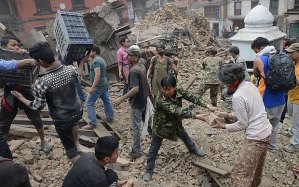
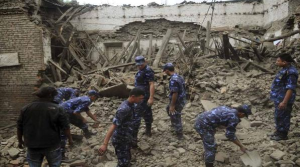
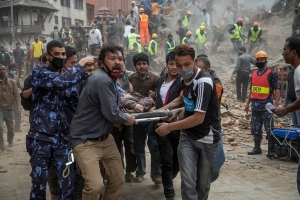
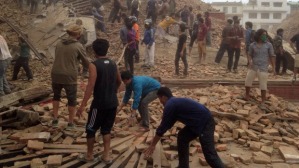
Beyond the devastation, the piles of rubble, the collapsed walls and the pall of dust. Beyond the horror and tragedy of a fascinating, historic city shaken to its core and the flashes of grief on survivors and injured alike.
You see people. Dozens of them. Hundreds of them. Nepalese people, crawling over the rubble, hauling at debris, digging out survivors. You see them working in teams, long chains of hands clearing fallen masonry, working as teams, high-visibility vests mixed in with office clothes and people just out in the street. From the images, it’s impossible to tell how many of these teams are spontaneously responding, and how many are being coordinated by emergency personnel. But with very few exceptions, they are almost all local Nepalese. They are acting within minutes and early hours of the earthquake. And anecdotally we know that the majority of this response is happening in an ad hoc manner as people try to save those immediately around them when the disaster hits, or who rush home to save families, friends and neighbours.
These are the people who will save lives by the tens of thousands.
These are the volunteers we need more of.

Swayambhunath (Monkey Temple), 2007

Swayambhunath (Monkey Temple), March 25, 2015
Now, the majority of this ‘voluntary’ action is spontaneous. It’s going to happen, regardless of whether we try and make it happen. If there’s one thing we’ve seen time and again following a disaster, it’s that in those moments of life-and-death, in the midst of horrific tragedy, a huge majority of people simply shine their brightest. In a disaster like this, what you don’t see is everybody just sitting around the piles of rubble going, “hey, let’s wait for somebody else to sort it out”. No, you see people getting in there, getting filthy and bloody, risking collapsing buildings coming down on their heads to save friends, loved ones and absolute strangers. I am a firm believer that, despite the overwhelming crapness that news media chooses to share with us from around the world, most people are inherently good and, when the chips are down, many prone to incredible selflessness.
But we can- and must- do things to facilitate this action to happen. Governments, the UN, NGOs and donors (especially donors) need to make sure that local community members- be they Haitians, Nepalese, Ni-Vanuatu, or any other disaster-prone location- are prepared, resourced and enabled to respond to save lives.
This is the domain of what in the aid industry is called “Disaster Risk Reduction” (DRR)- one subset of a large and [finally] growing set of programs that aim to make nations and communities in disaster-prone areas more resilient, more able to cope and respond, and- crucially- less vulnerable to disaster events.
The earthquake in Nepal was not (unlike that in Port-au-Prince) in any way unexpected. Disaster professionals have been talking for years- decades- about the earthquake threat to Kathmandu. The city’s location on a fault-line, the high population density, the poverty, the poor building practices and the way fragile brick structures were piled one on top of the other, and the isolation of the city high in a ring of mountains, were all factors that combined, made alarm-bells ring.

Kathmandu skyline, 2007
Nor were these alarm-bells ignored. There have been trainings, response plans, mitigation plans, public policies and drills. The UN, NGOs, and the government have all worked together, on paper and in practice, to prepare Kathmandu for an earthquake. We won’t know until the after-action reviews come out just how effective these measures have been. But the very fact that the conversations were happening and contingencies considered means that both government and aid workers were in a mindset to respond once the disaster hit- a critical psychological edge.
I know anecdotally that my own organization has carried out multiple response drills, has extensive response plans in place, and has a cadre of disaster-ready personnel among its local staff, as well as in its community programs. Their country director, a friend of mine, has a long pedigree of disaster response, which no doubt contributed to her being placed in a position of responsibility in an earthquake-prone office. She and I joked when she was first appointed that I’d be joining her shortly, once the earthquake hit.
We were all expecting it, and we were all planning for it.
So how do we save lives? We make sure that local community members- everyday citizens- in the countries we work are prepared and equipped to the best extent possible. And we encourage them to get on and do it.
- Awareness-Raising (as a conversation)
As with any activity, the first place to start is making sure that everyone has the same information. It’s patronizing to think that external organizations can walk into an urban or rural community group and tell them “these are what your risks are”. In most cases, they know these things far more acutely than you do. That said, in many cases, certain risks (such as a massive devastating earthquake) may be deprioritized in a community because it’s been so long since one was experienced that it may not be perceived as a critical risk. Mutual learning has to take place. As external actors, it’s essential to respect communities’ perspectives on what is important to them. It’s also important to learn what their existing coping mechanisms and plans are- it’s unlikely that you’ll be coming in to a blank slate. They may have traditional responses. Elders may have memories of earlier events and what was done. All of this has to be factored in. At the same time, however, if a threat is genuine & building (such as an imminent earthquake), communities not already aware of this threat need to be brought up to speed. It’s a conversation. Facipulation? Try and avoid it. Apart from anything else, communities are made up of people, and people, by and large, are smart- especially when it comes to survival- so it shouldn’t be a hard job. Just do it right and do it respectfully and humbly. But between external actors and community groups, there needs to be a common understanding of what the threat to the community is, and how best to tackle it.

Community artwork as part of an NGO DRR program in Latin America
- Invest in National-Level Response Structures
In more developed countries, emergency response is a blend of professional emergency services (911 operators, police, fire brigade, ambulance drivers, etc.) and trained volunteers. Here in Victoria, mobilizing large-scale civilian emergency response happens in a very structured way in response to large-scale disasters, either through the State Emergency Services (SES), or the Country Fire Authority (CFA). Both agencies have a similar structure and approach, with a relatively small core staff of full-time professionals who oversee the organizational integrity, and a very extensive network of trained volunteers with appropriate skillsets. Volunteers are drawn from and attached to community-level response teams, with the possibility to deploy into other geographical areas, which means that at their most basic, volunteers are often motivated by the desire to protect their own towns and suburbs, and by extension, homes and families. It’s a highly effective structure, and one that gets utilized year in and year out here (in Australia, the country where everything is trying to kill you).
Less developed nations are increasingly adopting similar mechanisms, to greater and lesser degrees and effect. Investing in these structures, from central government to regional and sub-regional levels, is critical to ensure sustainability, continuity, and effectiveness. These government programs are usually national in scale and with a reach that no single aid agency or donor is going to be able to achieve. The most successful models I’ve seen on the ground- primarily in Latin America- have brand recognition down to the community level, and are present in pretty much every at-risk administrative zone. Supporting and enabling these organizations will have far greater multiplying consequences than a stand-alone program.
What does this look like? Obviously, it means funding them. It means training their core staff- at higher levels, in effective response management, and at lower levels, the critical technical skills required to respond. But it also means that in your community-level engagement, your DRR messaging is in line with that of the national response agency’s (and if you disagree with that messaging, then negotiating directly with that agency, rather than going cowboy). It means ensuring that you’re identifying gaps in their training and resourcing, and working with them on agreeing how to fill those gaps. It means ensuring that any community-level structures you put in place are directly compatible with national disaster response agency processes and structures. And it means that, when you launch your response, you ensure your agency (and any community-level mobilization you do) is slotting in to that structure, not working over or against it.
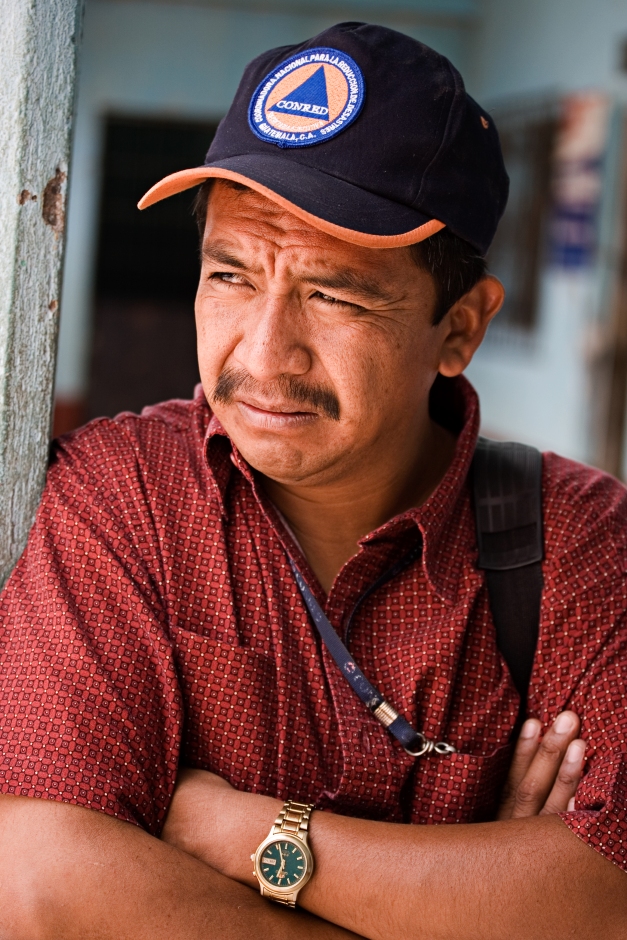
Civil Defence personnel working with an NGO DRR program in Guatemala
- Drill, Drill, Drill
The most effective way to ensure that responders will do the right thing in an emergency is to have them dry-run it, in simulation exercises and in repetitive drills. The more you can do this, and the more realistic the circumstances, the more likely people are to get it right when the real event happens. Not only are their skills more robust, but they understand what to expect (which boosts psychological resilience), and how to fit in more efficiently and effectively with higher-level structures. This in turn allows them to more effectively mobilize additional resources.
Community brigades need to understand basic SAR techniques, and life-saving first-aid. They will be responding, regardless of whether any external actors get involved. They will inevitably be at their homes, scrambling through debris to pull out loved ones. How can we help them more effectively work together as teams? Prioritize disaster sites? Safely remove rubble and ensure nobody else is hurt and killed? Communicate when communication lines are down and they need a medevac, or critical resources? What equipment can we help them acquire and maintain that might save lives, which can be kept on-hand and be ready to use when disaster strikes?
None of this is without its challenges. First aid supplies get pilfered, equipment rusts or is sold when it appears defunct and no emergency has occurred, and training has to be maintained to stay current and effective. But we have to look at communities as our first responders, as the people who are going to save the lives whose fate will have already been resolved long days before our teams actually reach them.
At a higher level sophisticated simulations allow national response agencies to understand how to interact with the inevitable international response system that will arrive in force in the hours following a disaster. Teaching them how to work within coordination mechanisms, how to leverage for support and how to communicate and fill gaps in capacity and response is crucial. Likewise, the UN and agencies absolutely must drill their responses with national response agencies involved, or they risk ignoring or undermining the single most critical activities taking place during the first 72 hours following a rapid onset disaster.

Community members, part of an emergency response committee in Ecuador, drill first-aid and casualty evacuation in preparation for a disaster event
- Give, Give, Give
This one’s for the donor agencies. DRR isn’t sexy. DRR investment is increasing, largely on the back of advocacy campaigns that have increasingly called on donors not to neglect preparedness funding. The Hyogo Framework has assisted this process as well. When I first started in this industry 12 years ago, getting disaster preparedness funding was like pulling teeth. This, at least, has changed.
None the less, because government donors often use overseas aid as a domestic policy tool, they give in accordance with the attention of their constituents, which in turn is driven by media attention that goes into a frenzy following a tragedy but tends to ignore the day-to-day stuff. An oft-quoted figure is that $1 spent in DRR programming saves $10 in disaster response spending. And that’s just cash. Never mind the lives that are saved by effective DRR.
This spending needs to go into the high-level stuff: Government policies, retrofitting, building codes, urban planning & development, and training and equipping national disaster response agencies. It also needs to go into the community-level stuff. Local risk mitigation plans, training and disaster simulation drills, and everything in between.
Agencies need to do likewise, and never stop pushing the DRR agenda. And- for both donor agencies and aid organizations alike- continue to push for the understanding that DRR is not an emergency response issue- it is a part of any and all good development. This conversation, I’m happy to report, is a mature one in many parts of the development sector- but DRR can still feel like a tag-on or optional extra, and often gets left on the sidelines like an ugly step-sibling. It mustn’t be. DRR done right will directly contribute to more saving of lives than most other development or response activities out there.
- Post-Disaster Support
In the communities that response agencies ‘take on’ as their own, they need to treat community members less like ‘beneficiaries’- which is really just a politically-correct way of saying ‘victims’- and more like staff-members. Community members are our first responders. They are in a very real way our partners on the ground. They are doing the work of saving lives, and our hope as response agencies has to be- very humbly and carefully- finding a way to support them as best we can.
Just like our staff members need support in a post-disaster setting, so do our community first-responders. For the first 24-72 hours, these people will be running on adrenaline. They will be driven by the primal need to save the lives of people they love. Some will be successful. Many will experience devastating grief.
And like all humans, that grief will have different impacts, and will need to be handled differently. Response agencies moving into a community need to be acutely cognisant of how to support people in this situation.
Agencies need to learn how to utilize Psychological First Aid (PFA) and other basic psychosocial programming. Just as psychological support for aid staff is becoming increasingly mainstream, this needs to be extended to community-based first responders. For some of them, being kept busy- utilized further in response programs, either as volunteers or as newly-hired staff- will be critical. Others may require rest, and being allowed to stop and mourn. In response activities, flexibility to cater for a range of first-responder needs has to be built in across the program- ‘mainstreaming’, to use a dirty word.
But the critical thing to remember here- communities are never passive victims. They are our first-response partners, they are the people who risked their lives to save others while we were still sitting in airport business lounges, and they are the people who will carry the weight of what just happened for the rest of their lives. They are, and must be, our number one priority as external responders. We must celebrate them and their achievements, enable and support them, and avoid disenfranchising or patronizing them at all costs, lest we add to the harm they have already experienced.
Let’s make sure that in all our response and pre-response programming, we are enabling community-based volunteers at every opportunity. These are the people who will save the lives we never get a chance to.








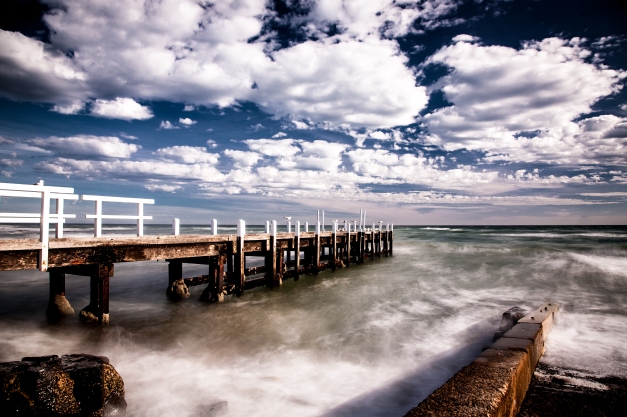


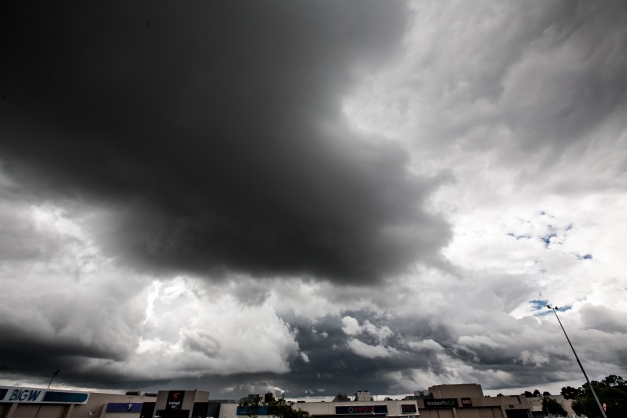
 Trying to balance the light across a frame is a fundamental part of photography. When the sun is out, this is easiest, as the sun throws lots of light onto the foreground of the shot, while the sky is comparatively darker. The variation of light coming off both ground and sky is relatively similar, and all parts of the image can therefore be quite well lit.
































 WanderLust


